I want to build a private, closed landline network where kids can talk safely to their friends.
Each pod is a VoIP phone that only connects to other pods on the same network — no internet strangers, no smartphones, no ads. Just safe, simple voice communication.”
Can this be done?
It sure can be. How you want to do it will be based on your own needs and wants for the project.
Great news. Just joined didn’t even know this existed to wonderful to receive a response.
I own a small IT business re[pairing computers and branching out into the security and well being regarding children. I have boys aged 11 and they are quite happy with a dumbphone - but they message constantly their friends and they love a good natter. So bring back the old days of chatting with the phone on the stairs to friends. I was thinking of walkie talkies or CB radio but limited range.
A company called TINCan has the right idea.
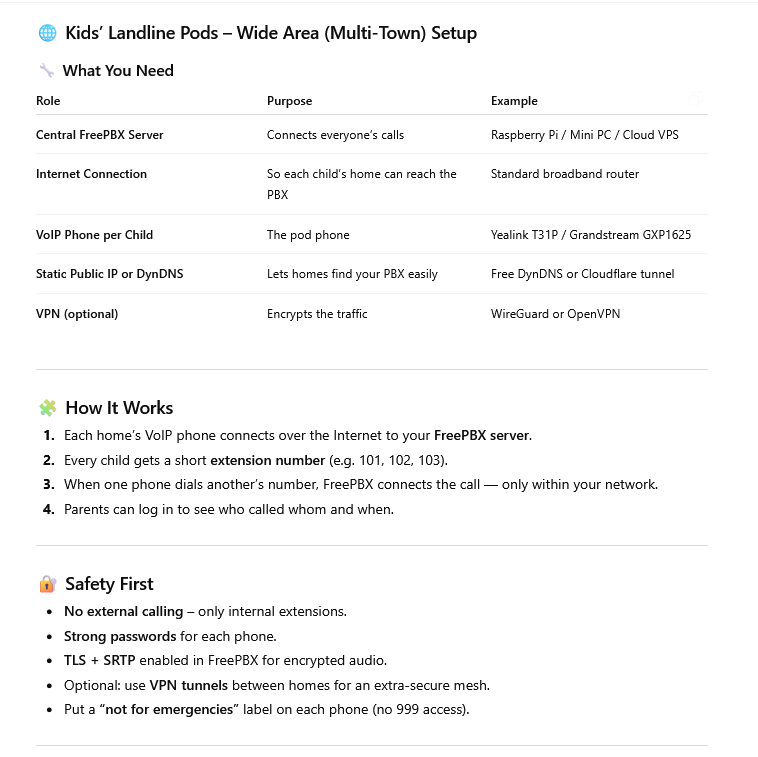
I have been using ChatGPT to assist not sure if you can see image..
But if you can point me in the right direction where there are guides to help with this - Bonus
You’re just setting up a PBX that all the phones connect to. It just won’t have external access to make calls. It will just be limited to the internal extensions you setup.
Perfect 
@SafeguardNI Welcome to the forum and thanks for checking out FreePBX!
Absolutely - Just a few things to consider.
What type of phones do you intend to use, Old school analog or VoIP?
Do you want access to 911?
It’s going to be VOIP. Trying to make it as child friendly as possible.
I am based in the UK so the police would be 999. I have no intention of letting the children be able to contact the Police. They have their dumbphones if that is necessary. It’s just so they can sit back and chat with friends - perhaps arrange a date to play football or go to the park..
Okay - So in this case, all you will need are some voip phones and a working FreePBX. As other said in the thread, this will be extension to extension calling only - no need to set up a trunk to the outside world.
It’s not going to be quite as straightforward as that. You’ll need to ensure that the phones are locked down, against local reconfiguration, and full URI dialling, are properly firewalled against direct “connections” (although NAT at the phone end may go most of the way), and you will need to, at least, consider, the impact of dynamic addresses and NAT, at the phone end. Ideally the PBX end will need a static public address.
Also the US system seems to allow each parent to set the list of allowed numbers. I don’t think that will work well within the limits of FreePBX, so you would need to think of bare Asterisk. It one scale without that, as one child’s friend will be another child’s stranger, or at least be considered an undesirable element, by the parents.
Actually, as you would need a completely new configuration front end, that would be another reason for using bare Asterisk.
I’m curious to know how the US system copes with the legal requirement for 911 access from any phone with the ability to dial. As far as I know, that does not currently exist in the UK.
You’re joking, right? He’s building a closed system for kids.
This is interesting. Even if you wanted these phones to only be able to dial emergency services, other than internal extension dialing, that would entail an outbound route only having the emergency service dial pattern. With a SIP trunk configured, of course.
A few years ago I recall playing with this 2G Experiment. Got it working on a few old Nokias around the house. Then shut things down, seeing I don’t like white vans camped out across the street. 
If the system is internal and has no connection to the PSTN then there are no requires for 911.
The US system he cites seems to be half open, in that it is a service which allows parents to subscribe their children, and nominate which other specific children they are allowed to dial, or receive calls from. He’s looking into doing similar, as a commercial venture. This isn’t a toy telephone system within a single house, and it is not even one with just 10 to 20 subscribers well known to each other. It’s basically a system with every user being in their own class of service, so having an individual set of callable numbers. It’s a bit more complex than class of service, as the restriction would have to be imposed on the source caller, based on the destination’s parents’ policies, as well as the source’s parents’; calls would only be possible if both sets of parents approved of the particular pair of children communicating with each other.
It’s a business proposition which will only make sense if the subscriber base is large, and I don’t think they are assuming their will be lots of isolated islands of around 10 children each, as against a situation where there will be overlapping peer groups. For a start, children may be in a peer group resulting from being in the same year at the same school, but also in a peer group from extended family, and the school peer groups might extend a year either way, but not across the whole of the school.
Some parents may want to lock out a particular child, as an undesirable influence, but others may take a more relaxed view, so you will not be able get an island that doesn’t exclude some children, at the same time as applying the restrictions that some of the parents want.
If he uses off the shelf phones, they may well be mistaken for emergency call capable phones by baby sitters, or other visitors. It looks like the US system uses customised phones. (As he is in the UK, I haven’t heard of any rules requiring the ability to call emergency numbers from any phone that looks like it can do so, so the OP doesn’t currently have to consider that possibility.)
Another thing to consider is that there are news reports, from time to time, of very young children making valid emergency calls, when a parent becomes incapacitated. I guess with the death of normal landline phones, and the ability of locked cell phones to still make emergency calls, children could be trained to use the cell phone in such cases.
Hear me out… what if the “emergency” call went to all the friends ?
In the scenario where Alice and Bob live a block away from each other, then it might help precipitate faster, more contextualized response times.
This is not necessarily mutually exclusive with US 911 regulations – it could be an enhancement, using parallel dialing and conference bridges, for example (dabbled on the edge of this with ABC).
Is no longer in business and that project is dead. It never made it to the new regulations in the US. If the OP is outside the US then the OP needs to follow any regulations of the country they are in.
If the OP is in the US and wants to make this commercial then they need to look into what regulations they need to follow.
As a commercial option I am not sure the viability of it in 2025.